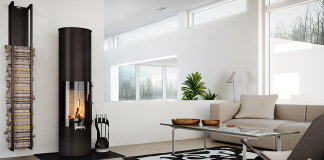

Your eyes judge a room’s size mostly by its floor. A rug sits on top of that measurement, so it can make a compact room look open or cramped.
Plenty of people get this backward. They assume a small room calls for a small rug, buy something tiny, and end up with a room that feels choppier. Figuring out how to make a small room look bigger with a rug comes down to four choices: size, placement, color, and texture. With all four in place, the same square meters feel roomier.
The Best Rug Size for Small Rooms
Buy bigger than your instincts suggest. A rug measuring 120 by 180 centimeters under the coffee table creates what designers call the postage stamp effect: a small island in a sea of bare floor. The wide band of empty boards makes the furniture look shrunken, similar to the Delboeuf illusion, where a circle looks smaller inside a larger ring. Interior designer Emily Henderson notes that an undersized rug can leave a room looking smaller and chopped up.
Use these sizes as a guide:
| Room | Rug size | Fit guide |
| Living room | 200 by 300 cm, or 160 by 230 cm for a two-seat sofa | 15 to 25 cm past each sofa arm |
| Bedroom (double or king) | 200 by 300 cm | 45 to 60 cm showing at sides and foot |
| Dining area | 200 by 300 cm, or 200 cm round | At least 60 cm beyond the table |
| Hallway | Runner 75 to 80 cm wide | 7 to 15 cm of floor on each side |
Already own a rug that’s too small? A deep clean from professional carpet and rug cleaners can freshen it for a new home in a bedroom or study, freeing the living room for something larger.
Rug Placement Tips for Small Spaces
Your brain treats objects that share a boundary as one group, a principle psychologists call common region. Scatter a sofa, armchair, and side table across bare boards, and the room reads as clutter. On one rug, those same pieces become a single seating area.
- Living rooms: Rest the front legs of the sofa and chairs on the rug, back legs on the floor.
- Bedrooms: Run the rug perpendicular to the bed, under its lower two-thirds. In a very tight room, slim runners flanking the bed can replace one large rug.
- Dining areas: Every chair should stay on the rug when pulled out. If that pushes the rug against the walls, skip it.
- Studios: Leave 60 to 75 centimeters of bare floor between zoned rugs.
- Every room: Keep 20 to 30 centimeters of floor showing along the walls, and line rectangular rugs up with the longest wall.
Pair those rules with furniture pulled slightly away from the walls, and light can travel around each piece.
Rug Colors That Make a Room Feel Larger
Pale neutrals such as cream, ivory, oat, and light gray reflect more light than deep shades, brightening shadowy corners and letting the floor’s edges fade back. Soft sage or muted blue helps too, because cooler colors tend to recede while warm reds and oranges advance.
Watch the contrast with your flooring. An ivory rug on dark walnut draws a hard outline, and the eye stops right at that line. A tone within a few steps of your floor makes the transition almost disappear.
Dark rugs still have a place. In a snug den with charcoal walls, an ink or forest green rug blurs the line where floor meets wall, making the room seem deeper. Trouble starts when a dark rug lands in a bright white room.
Which way your windows face also changes how color reads. North-facing U.K. rooms get cool, flat light that dulls pale gray, so warmer neutrals such as linen hold up better. A mirror hung opposite the window adds more light for the rug to catch.
Pattern, Pile and Texture
Oversized motifs and bold graphics, such as a black-and-white chevron, pull the eye straight to the floor. For anyone collecting small room decorating ideas with rugs, quieter options work harder: tone-on-tone weaves, fine geometrics and faded traditional prints. Stripes earn their spot in narrow rooms when they run lengthwise toward the far wall.
One well-sized rug beats a cluster of small accent rugs. Several little pieces break the floor into patches and chip away at the clean, minimalist look that suits compact rooms.
Then there’s pile height. Low-pile rugs and flatweaves under 1 centimeter cast almost no edge shadow and let chairs slide easily. Deep shag feels cozy, yet it adds bulk a small room can’t hide. A thin anti-slip rug underlay keeps corners flat and holds the rug in place on hard floors.
How to Choose a Rug for a Small Living Room
Start with a tape measure and record the whole seating area, coffee table, and accent chairs included. The sofa alone gives a misleading number. Next, outline the rug with painter’s tape and leave it down for a day. Problems show up fast: an edge crossing a doorway, chairs with nowhere to go, or an uneven border.
Before buying, open and close every door nearby. Many interior doors clear the floor by only 1.2 to 1.9 centimeters, and a plush rug on a thick pad can jam them. Wool is a dependable fiber since it springs back under furniture feet. Flat, washable synthetics suit homes with pets.
Professional Rug Cleaning to Maintain Small Room Aesthetics
A light rug keeps a room bright only while it stays light. Grit clouds pale fibers quickly, and in a small space a stain has nowhere to hide. Vacuum weekly with a suction-only head, as beater bars can fray flatweaves and low loops. Rotating the rug 180 degrees every six to 12 months evens out wear from sun and foot traffic. Spills need blotting from the outside in, never rubbing.
When dirt settles deeper than a vacuum can reach, book a professional wash. It helps bring back the pale, even tone that made the room feel open.