
The year was 1935 when food critic Curnonsky called Lyon, “the world capital of gastronomy,” and all eyes turned in unison. Decades later, we are yet to look away. Now, 3 régions between Dijon and Marseille via Lyon – Bourgogne Franche-Comté, Auvergne-Rhône-Alpes, and Provence-Alpes-Côte d’Azur – form France’s Valley of Gastronomy. I went on a road trip through Auvergne-Rhône-Alpes with a group of food writers, and I have notes.

First, everyone should follow the region’s Michelin stars like the three wise men followed a star to baby Jesus. Eat at as many as you can afford. Second, don’t lose sight of the fact that the valley’s bounty is everywhere – especially in the smallest of encounters.
Stop 1: Lyon

Let me illustrate the second point. On my first morning having breakfast at Fourvière Hôtel Lyon it felt as though I had just discovered butter. The softness of the in-house butter as it spread on my toast, the translucence of its colour and the creaminess of its taste had me questioning everything. Tell me! Where do the cows live? What do they eat? That butter was the only thing on my mind as we walked through the Renaissance district of Old Lyon later that morning.
Old Lyon has been protected by Unesco since 1998; the buildings are some of the finest examples of Renaissance architecture. In between, was the odd bouchon – restaurants which, historically, were run by women known as Mères Lyonnaises (Lyonnaise mothers). Red gingham tablecloths are their trademark, and perhaps a pot of wine on the table. Those with discerning palates argued that the best bouchons are outside Old Lyon in Vaise, Croix-Rousse, and La Guillotière. Yet, while traditional dishes like cervelle de canut (garlic, shallot, and herb infused soft cheese) were missing from the menus served to tourists, as an experience, these bouchons were a satisfactory consolation.
Early next morning we headed south. Over the next 4 days we would cover 200 miles with stops in Hauterives, Tain-l’Hermitage, Grignan, and Nyons. Anyone recreating this itinerary will need a good set of wheels and a tank full of petrol; these, afterall, are the roads Michelin created stars for.
Stop 2: Hauterives and Tain-l’Hermitage
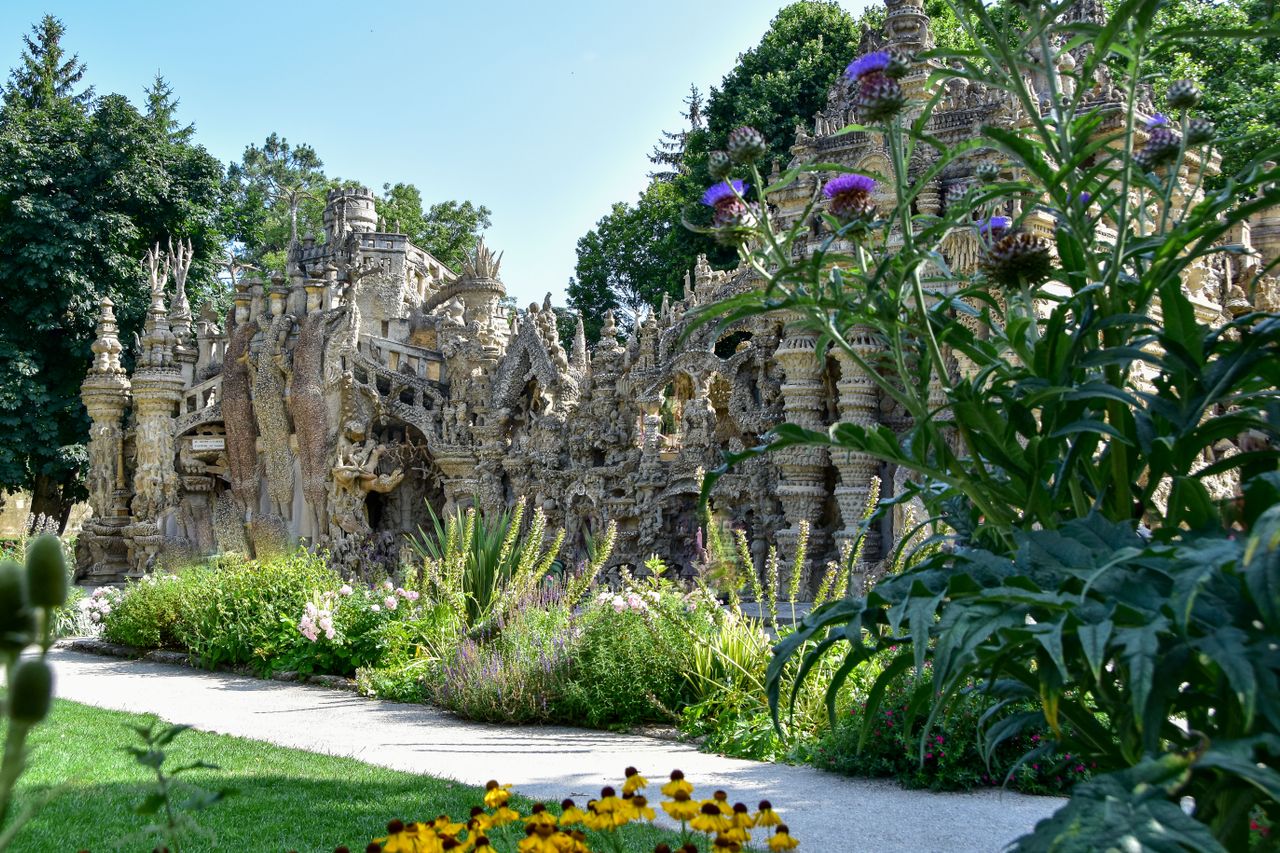
We arrived at Palais Idéal du Facteur Cheval (Postman Cheval’s Ideal Palace) in Hauterives by mid morning. It is a remarkable place dated 1899. Even more remarkable is that it was created by a rural postman, Ferdinand Cheval, using rocks he spotted while delivering mail. Inspired by images on postcards Cheval replicated what he saw in his vegetable patch. There is an Egyptian tomb, a menagerie, and even a replica of the White House that he built stone-by-stone, which still stands albeit now surrounded by a beautiful garden, museum, and gift shop.
“These are the roads Michelin created stars for”
It was during this visit that I spotted what looked like a bundt cake on a table in the restaurant next door – Le Clos. There it was in the shaded terrace, especially laid out to welcome our group. There were also 2 trays of croissants, and a ring-shaped bread. A plate full of apricots in the middle shimmered like little golden eggs.
I sliced myself a piece of bread. “It’s called pogne,” said Janine Marsh, editor of the magazine and website The Good Life France, who has lived in France for twenty two years. “A brioche flavoured with orange blossom.”
I tasted the entire valley in the mild yellow, airy, soft dough; delicately sweet with a hint of citrus. “Pogne is a speciality of the town Romans-sur-Isère, and the Drôme region where we are,” added our host at Le Clos.
I then turned my attention to what I had mistaken for a bundt cake – it was also a pogne, but this time, filled with sugared almonds coloured bright pink. Sweetening a treat without overpowering it with sugar is, I believe, uniquely French; perfectly executed in my first taste of pogne.
From here our next stop was Cave de Tain vineyard. It was a couple of hours away and we were to have lunch at Le Fief de Gambert restaurant at the centre of the vineyard. Only a fool would not drink wine in France. In the heart of the Rhône Valley, with a 2000 year history of producing wine, it would be a desecration. When we sat down to lunch, Guillaume Reynaud, Training Manager at Terra Rhona Professional School for Wines and Spirits, shared stories of playing amongst these vines as a boy. I figured that at this point Cave de Tain wine probably runs through his veins. Reynaud shared his knowledge generously. As someone who cannot bear the snobbery around wine, my greatest take away from it was this:
“The best way to drink wine is however you like it,” he said.
The insufferable may need to cover their ears for the rest of this.
“If that means microwaving your wine before you drink it, that’s completely fine.”
Stop 3: Grignan
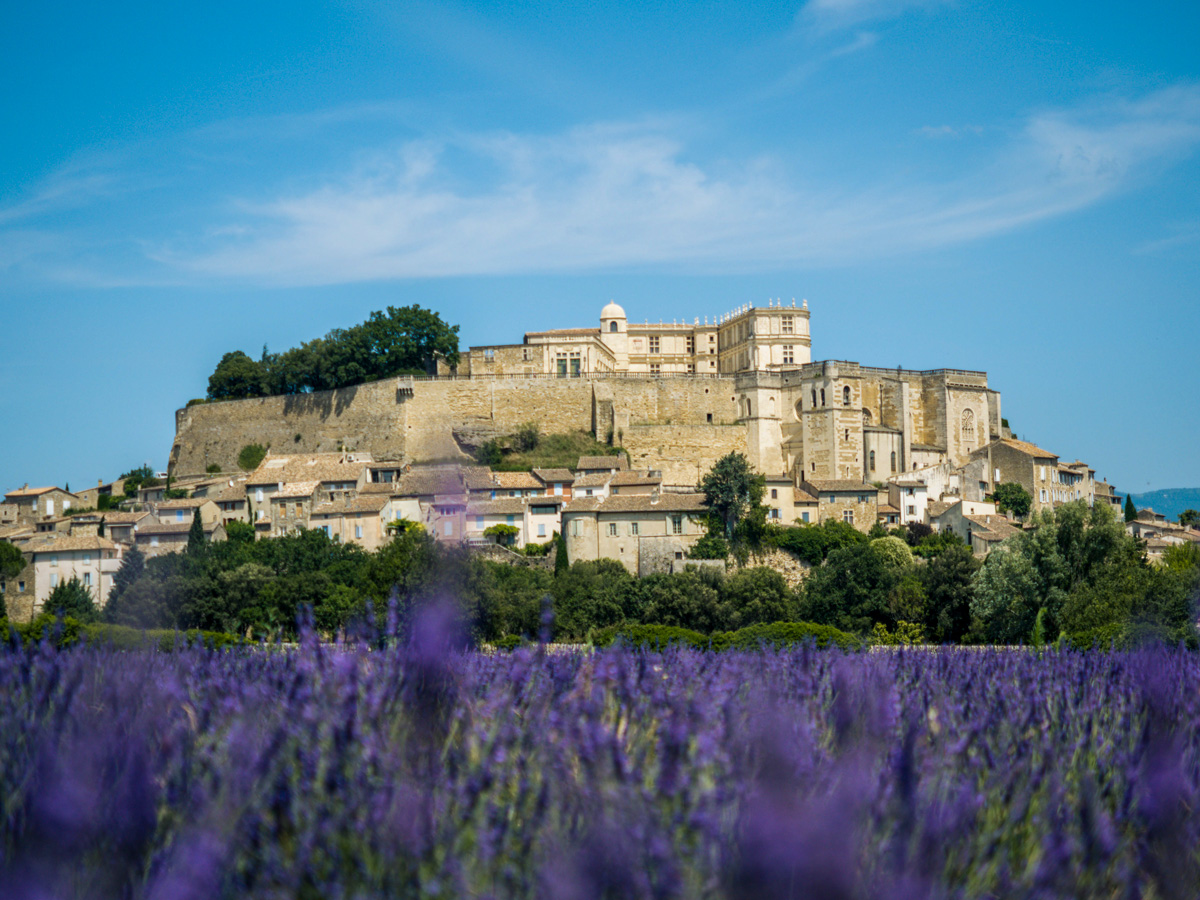
With that nugget in my pocket, and back on the road, the afternoon stretched lazily ahead. The landscape had been mostly vineyards and crops so far. I knew we were approaching Provence when the unmistakable purple hue of lavender fields shimmered in the distance like a mirage. Folklore in Provence goes that the purple of lavender happened because of the blue tear drops of Lavandula – a fairy no taller than a thumb. When she cried, wherever her tears fell a stem of purple lavender pushed through the soil. Lavandula’s tears guided us to our destination Grignan – a 12th century town.
It was late afternoon when we arrived and checked into our hotel. I was sipping wine outside Bistrot 270 that evening when someone whispered in my ear, “The French always keep the best for themselves.”
I had always suspected this. But I empathised with the French for gatekeeping Grignan – if this was not a work assignment I would have done the same to protect it. Grignan is classified as Plus Beaux Villages de France – one of the Most Beautiful Villages in France. It is a dream of a place that pleases all the senses. Fields of lavender roll down from hilltop Grignan Castle. We visited L’Essenteil de Lavande farm and made lavender body butter. It was here that I tasted another Provence specialty – corquant aux amandes. The thin and impossibly crisp biscuits had been freshly baked with almonds and lavender. They were served with a thoroughly refreshing almond syrup and water. We also followed Tilia, a family dog with possibly the best nose in the business, around Truffière La Baume Saint Antoine where Tilia sniffed out an 80 gram summer truffle, under a white oak tree, within 10 seconds.
Back in Grignan – the town’s most famous resident was Madame de Sévigné, who lived in the castle for 4 years during the Renaissance, and wrote evocatively to her daughter, Françoise-Marguerite, about daily life. These sentimental letters have become some of the most famous correspondence in French literary history. Madame de Sévigné left an inimitable impression on Grignan, and the memory of her touches everything like sunlight. A fountain and bronze statue in Place Sévigné pays homage to a lady that became Grignan’s forever beloved.
During my 2 days here I took a slow walk along a cobbled path up to an old book shop, sipped wine at sunset to the gentle voice of a local singer, and sat out late during balmily warm evenings. By night I rested at the magnificent Les Maisons du Clair de la Plume. It is a mix of 19th century and contemporary rooms and suites, a Mediterranean garden with pool, a Michelin starred restaurant, and a cafe spread across 6 sites around the village.
In over ten years of travel I have been fortunate to stay in some of the world’s finest hotels. Yet, from the faultless service to the unique beauty of its setting, and the understated grandeur of its historic buildings I will say that this boutique hotel, in the middle of the French countryside, is by far, the best of them all.
Stop 4: Nyons

On our last day in Drôme we made a final stop at Nyons Market. It screamed Provence on all counts; olive oil sellers, hand-spun lace stalls, and little cafes at every corner where locals and tourists sipped coffee while being entertained by either a guitar player or a singer. We also had a taste of French cookery at Maison de Huiles & Olives, in the very heart of the market, and learned how to make bread sticks and tapenade before lunch. Dessert that followed was a piping hot apricot tarte tatan. The thing I remember last is that I loosened my buttons, and wolfed down a third slice of that tarte tatan.
The next day I headed to the airport with my bag laden with 3 types of olive oil, 2 jars of olives, 2 jars of capers, and 4 packets of Herbes de Provence. Well, I thought, they don’t call it the Valley of Gastronomy for nothing.